Nice to be back at DESTRUCTIBLE MAN after several long gaps. To be honest, it wasn't until the recent spate of emails and comments that we realized that we'd even been MISSED! Good to know. We were especially happy to learn that Uncle Bob Martin, the original editor of FANGORIA from back in its halcyon days, is a regular reader! He had these very kind words for the Brothers Maciste on Facebook:
"Great fun site. The format reminds me of the old FM (Famous Monsters) film-photobooks, but with sharper more pertinent prose, and actual clips."
Owned.
More excitement ahead in the next couple of weeks -- the Brodos have been hard at work on our magnum opus (and plenty of medium opi) -- a mammoth piece of analysis that we are bwoiling our widdle bwains over. Should be finding its way above ground sometime in the very near future, unless it catches sight of its own shadow...
As if the promise of more Us isn't enough -- tonight, the Macistes are having family over for dinner! Another brother's in the house and he's doing (most of) the cooking! We are pleased as punch to formally welcome 42nd Street swillhound and Grand Rebbi of the hallowed TEMPLE OF SCHLOCK, Chris Poggiali, into the Flying Brotherhood of the Macistes with his monumental analysis of Monte Hellman and Michael Carreras' SHATTER. Another double dummy-death for your consideration.
Enjoy and please leave your comments in the donation box that will be passed around shortly.
Thanks
The Management
post © Howard S. Berger & Kevin Marr

Wednesday, February 25, 2009


Thursday, February 19, 2009
Night Train Murders - L'Ultimo treno della notte (Aldo Lado, 1974)
How I spent my Xmas vacation...
 A tale in the true spirit of the holidays, NIGHT TRAIN MURDERS depicts the travels of two teenage girls on a train ride home for Christmas.
 Like Ebenezer Scrooge in Dickens' A CHRISTMAS CAROL, the girls learn a lesson --
 -- in Scrooge's case, it was "good will to all men" --
 -- for the girls in NIGHT TRAIN MURDERS --
 -- the lesson is: "trust no one, for they will all rape, genitally mutilate and murder you."

 Deceptions and transformations abound. Friendly travelers reveal sexually sadistic, psychopathic natures...

 ...and one of the girl's outwardly square, socially upstanding mother and father, initially antagonistic towards each other, turn their mutually repressed sexual frustrations outward and transform into remorseless, vengeful killers against those responsible for their daughter's murder.
 The very nature of the film is a subterfuge unto itself. Director Aldo Lado claims themes of a deceptively evil bourgeoisie manipulating the lower class into doing it's baneful handiwork --
 -- a perfectly acceptable rationalization by an intelligent director who needs to validate his involvement with a project whose commercial intentions demand a copy of Wes Craven's wildly successful LAST HOUSE ON THE LEFT (1972) for the European market.
 He certainly fulfills his chores nicely --
 -- the characters are graphically debased and tortured for the lower class audience's entertainment and the bourgeoisie audience is shamed for observing while simultaneously applauding Lado's critical social statement. Job well done.
 Of course, Lado's characters aren't the only ones whose innocence and dignity have been desecrated -- the director manages his most ingenious strike against actor and audience alike by transforming the young actresses portraying the tragic victims into full-blown mannequins as both characters are chucked from the moving train by their vicious captors.
At once, an end to the tragic spectacle of savagery for the characters and a literal underscoring of the dehumanization both actresses of said spectacle must endure and live with for the rest of their actual lives.
The gift that keeps on giving.

{This post is part of Arbogast on Film's The One You Might Have Saved Blog-A-Thon}
post © Howard S. Berger & Kevin Marr
 A tale in the true spirit of the holidays, NIGHT TRAIN MURDERS depicts the travels of two teenage girls on a train ride home for Christmas.
 Like Ebenezer Scrooge in Dickens' A CHRISTMAS CAROL, the girls learn a lesson --
 -- in Scrooge's case, it was "good will to all men" --
 -- for the girls in NIGHT TRAIN MURDERS --
 -- the lesson is: "trust no one, for they will all rape, genitally mutilate and murder you."
 Deceptions and transformations abound. Friendly travelers reveal sexually sadistic, psychopathic natures...
 ...and one of the girl's outwardly square, socially upstanding mother and father, initially antagonistic towards each other, turn their mutually repressed sexual frustrations outward and transform into remorseless, vengeful killers against those responsible for their daughter's murder.
 The very nature of the film is a subterfuge unto itself. Director Aldo Lado claims themes of a deceptively evil bourgeoisie manipulating the lower class into doing it's baneful handiwork --
 -- a perfectly acceptable rationalization by an intelligent director who needs to validate his involvement with a project whose commercial intentions demand a copy of Wes Craven's wildly successful LAST HOUSE ON THE LEFT (1972) for the European market.
 He certainly fulfills his chores nicely --
 -- the characters are graphically debased and tortured for the lower class audience's entertainment and the bourgeoisie audience is shamed for observing while simultaneously applauding Lado's critical social statement. Job well done.
 Of course, Lado's characters aren't the only ones whose innocence and dignity have been desecrated -- the director manages his most ingenious strike against actor and audience alike by transforming the young actresses portraying the tragic victims into full-blown mannequins as both characters are chucked from the moving train by their vicious captors.
At once, an end to the tragic spectacle of savagery for the characters and a literal underscoring of the dehumanization both actresses of said spectacle must endure and live with for the rest of their actual lives.
The gift that keeps on giving.

{This post is part of Arbogast on Film's The One You Might Have Saved Blog-A-Thon}
post © Howard S. Berger & Kevin Marr
Saturday, February 7, 2009
Les Raisins de la mort - The Grapes Of Death (Jean Rollin, 1978)
A glass a day keeps the doctor away...
A cautionary, metaphoric film of deceptions about the destructs of alcoholism -- spread throughout a society and culture, ironically, via the very fruit from which the desired libation is drawn.
 Jean Rollin is a Gallic director who emerged, full to form, simultaneously with the rumblings of the cultural and cinematic revolutions in late 1960’s France.


 For international cinema, and Rollin in particular, this was an age of raw creative expression and experimentation with film language --


 -- an age that acted as a playground for Rollin's offbeat tastes and talents.


 Les Raisins de la mort, a film made ten years past these events --
 -- in a far more commercially-minded and cinematically conservative age -- concerns Élisabeth (Marie-Georges Pascal) --

 -- a young woman traveling by train to see her boyfriend, Michael, a winery operator in Roubelais.


 From this simple idea, Rollin constructs a mystery of mounting deceptions, duplicity and transformations.
 The first, assumptive transformation is that grapes transform into wine --

 Grapes have no immediate toxicity but, in their aged liquidity, become toxic and ultimately, those that consume (in this case) wine in daily quantity take on an eventual physical and mental transformation.
 At the story's outset, a creeping rot has spread through the Roubelais vineyard and the grapes have become blighted.


 Rollin adds the super-natural element of pesticide as a metaphoric aide and convenient horror-genre convention.
 Michael is illegally spraying his own "homemade" pesticides on the grapes without properly informing his unprotected illegal immigrant employees about the potential hazards of the toxins they are forced to use.

 The pesticide transforms the wine into a harbinger of a sort of plague --

 -- one that instantly corrodes the mind (and flesh) of those that drink it and transforms them into near-mindless animals obsessed with the urge to kill.


 A witty exaggeration -- sometimes, perhaps not such an exaggeration -- of the natural effects of alcohol, in and of itself.
 However, there are those infected that can appear rotting in mind and body --


 -- and there are those whose mental and physical deterioration can be hidden --


 -- that is, until it is too late for individuals who have momentarily abstained from drink to escape the néo-zombies eventual de-evolutionary murderous rampage.


 There are even those whose physical condition remains intact while their psychopathia develops into a state of homicidal arrogance --


 -- allowing them the delusion of coherent, though insane, thought --


 -- cloaked in the illusion of sanity and physical perfection.


 Even Rollin’s visual style is a deception/transformation. Once a pop-surrealist steeped in Jungian colors --


 -- funereal locations --


 -- mordant antiquarian objets d’art --


 -- Magritte-inspired/Druillet-drenched tableaux --


 -- young women in creative states of dress and undress --


 -- here Rollin employs a seemingly straight-forward, unadorned rural French landscape not unlike Claude Chabrol -- utilizing natural light sources and a subdued color palette.


 Even the usually playful psych-tinged, prog-rock combo scores of his early films have metamorphed here into synthesized, faux-Philip Glass compositions --
 -- employed, not to comfortably signal an impending danger to the audience or augment a mounting suspense sequence in an effort to “involve” them in the shock and horror of what the main character is forced to both witness and experience; instead, it’s design is one of a rapid rotational series of tones -- hypnotic in their ceaseless repetition -- music that takes the viewer off-guard at the most crucial moments of surprise, especially when complimented with contrasting stretches of natural silence.
Rollin further illustrates the decade-long transformation of his directorial style by using Élisabeth's own prolonged transformation into the film's most complex, dignified, and compassionate zombie as metaphor for his own conformity to a new era of (outwardly less personal) commercial filmmaking.
 From the minute Élisabeth takes that fateful first sip, Rollin foreshadows and signifies her own prolonged transformation by providing sly visual clues --
 -- such as framing her with her own reflection --


 -- this mirrors the way Rollin photographs those afflicted in advanced stages of infection --
 -- a visual pun on his monsters dual and dueling personalities. He also, ever-so-subtly, hints at his heroine's eventual succumbing to the effects of the tainted vino by showing how she applies an increasing use of violence to survive --


 -- whereas earlier, at the outset of this crisis, she had found it just as easy to simply run away from her immediate dangers.
 Rollin masters this deception by introducing a trait unique to his particular brand of zombie: a tormented awareness of transformation --
 -- a physically and emotionally painful battle within oneself --
 -- the conscious understanding of involuntarily giving in to passionate, near-erotic murderous urges --
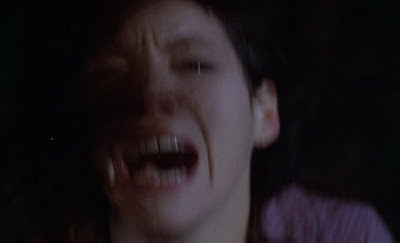
 -- and a clear regret at the abandonment of will. Élisabeth, herself, displays these very emotions in the many close-up reaction shots Rollin affords her throughout the film. (see examples above and below)

 It is as if she were watching, in others savage actions, the same terrible, helpless evil that is now gestating inside her. It's a complex and duplicitous subjectivity on display --

 -- one that the viewer is never certain about until the very final frames of the film. (see last photo sequence at bottom)
These accumulating deceptions/transformations lead us to (and substantiate) the film’s core moment of extremity; as always, the moment we Destructible Men exist for -- or -- as the French would call, the pièce de résistance:
CLOSE INSPECTION
In a small, cobblestone village, Élisabeth stumbles upon Lucy, a blind girl –
 -- already physically one step in the direction of the fantastic with her bright, pleading, white marbleized eyes –
 -- as she feels her way around a rural French country town looking for her guide, Lucas (Rollin’s “humanization” of a seeing-eye-dog).

 Little does she know that the quietly menacing townspeople, never kind to her affliction in the first place, are actually transforming into frothing, rabid zombie-like murderers all around her.


 Cue her adoring friend Lucas, who shows his love like any zombie-plague ridden Frenchman would --


 -- he promptly strips her nude and nails her to a door for all to see.


 Élisabeth, the story’s main traveler on the run (town after town) from these monsters, witnesses, not just Lucy’s crucifixion by Lucas --


 -- but his severing of her head with an axe as well --




 -- and his final proclamation of his love for her as he holds high the waif’s dummified noggin.
 This dummy-death is made especially indelible by director Jean Rollin’s unerring dual point of view during this scene. On the one hand, he has Élisabeth, horrified at the barbarism heaped on this delicate creature, incapable of stopping the savagery --
 On the other hand, he presents Lucas, who, spurred on by the extreme behavior induced by drink (in this case, highly contaminated French zombie-hootch) finally finds the courage to proclaim his love publicly as he holds his premier amour’s head up proud like a lantern that could finally guide him.

Terribly poignant and structurally rich, this décès d'un mannequin is at once poetically surreal yet technically perfect.
 The Lucy facsimile is so realistically sculpted, only a dummy wouldn’t envy Lucas’ (and more realistically, Rollin’s) possession of it.
 Everyone who populates this alcoholic landscape becomes something aggressively "less than human". The ultimate irony is that the one true chaste innocent is the only one to completely transform into a physically inanimate object. A mock holy ornament of symbolic purity, trust and love displayed before a flock of sinners teetering before the open gates of hell.

 With Les Raisins de la mort, Rollin once again uses his acute wit to employ a variation on that old Hollywood standard, "You only kill the one you love."


 So it is only logical to conclude Élisabeth's transformative odyssey with her killing her own boyfriend's killer (a man who did so at her boyfriend's own pleading request) --


 -- and the substitution of her boyfriend's blood for the wine that he himself was responsible for tainting.


 When all is said and done, Jean Rollin has fashioned, not simply an ironic tale of transubtantive vampirism, but a melancholy, metaphoric signaling of a master director's grappling with his own conscience over conceding to the fascistic stylistic dictates of modern commercial cinema.

post © Howard S. Berger & Kevin Marr
Thanks to Jeremy Richey over at Fascination: The Jean Rollin Experience - the FMB's favorite Rollin oasis on the net!
A cautionary, metaphoric film of deceptions about the destructs of alcoholism -- spread throughout a society and culture, ironically, via the very fruit from which the desired libation is drawn.
 Jean Rollin is a Gallic director who emerged, full to form, simultaneously with the rumblings of the cultural and cinematic revolutions in late 1960’s France.

 For international cinema, and Rollin in particular, this was an age of raw creative expression and experimentation with film language --


 -- an age that acted as a playground for Rollin's offbeat tastes and talents.


 Les Raisins de la mort, a film made ten years past these events --
 -- in a far more commercially-minded and cinematically conservative age -- concerns Élisabeth (Marie-Georges Pascal) --
 -- a young woman traveling by train to see her boyfriend, Michael, a winery operator in Roubelais.

 From this simple idea, Rollin constructs a mystery of mounting deceptions, duplicity and transformations.
 The first, assumptive transformation is that grapes transform into wine --
 Grapes have no immediate toxicity but, in their aged liquidity, become toxic and ultimately, those that consume (in this case) wine in daily quantity take on an eventual physical and mental transformation.
 At the story's outset, a creeping rot has spread through the Roubelais vineyard and the grapes have become blighted.


 Rollin adds the super-natural element of pesticide as a metaphoric aide and convenient horror-genre convention.
 Michael is illegally spraying his own "homemade" pesticides on the grapes without properly informing his unprotected illegal immigrant employees about the potential hazards of the toxins they are forced to use.
 The pesticide transforms the wine into a harbinger of a sort of plague --
 -- one that instantly corrodes the mind (and flesh) of those that drink it and transforms them into near-mindless animals obsessed with the urge to kill.


 A witty exaggeration -- sometimes, perhaps not such an exaggeration -- of the natural effects of alcohol, in and of itself.
 However, there are those infected that can appear rotting in mind and body --


 -- and there are those whose mental and physical deterioration can be hidden --


 -- that is, until it is too late for individuals who have momentarily abstained from drink to escape the néo-zombies eventual de-evolutionary murderous rampage.


 There are even those whose physical condition remains intact while their psychopathia develops into a state of homicidal arrogance --


 -- allowing them the delusion of coherent, though insane, thought --


 -- cloaked in the illusion of sanity and physical perfection.


 Even Rollin’s visual style is a deception/transformation. Once a pop-surrealist steeped in Jungian colors --


 -- funereal locations --


 -- mordant antiquarian objets d’art --


 -- Magritte-inspired/Druillet-drenched tableaux --


 -- young women in creative states of dress and undress --


 -- here Rollin employs a seemingly straight-forward, unadorned rural French landscape not unlike Claude Chabrol -- utilizing natural light sources and a subdued color palette.


 Even the usually playful psych-tinged, prog-rock combo scores of his early films have metamorphed here into synthesized, faux-Philip Glass compositions --
 -- employed, not to comfortably signal an impending danger to the audience or augment a mounting suspense sequence in an effort to “involve” them in the shock and horror of what the main character is forced to both witness and experience; instead, it’s design is one of a rapid rotational series of tones -- hypnotic in their ceaseless repetition -- music that takes the viewer off-guard at the most crucial moments of surprise, especially when complimented with contrasting stretches of natural silence.
Rollin further illustrates the decade-long transformation of his directorial style by using Élisabeth's own prolonged transformation into the film's most complex, dignified, and compassionate zombie as metaphor for his own conformity to a new era of (outwardly less personal) commercial filmmaking.
 From the minute Élisabeth takes that fateful first sip, Rollin foreshadows and signifies her own prolonged transformation by providing sly visual clues --
 -- such as framing her with her own reflection --

 -- this mirrors the way Rollin photographs those afflicted in advanced stages of infection --
 -- a visual pun on his monsters dual and dueling personalities. He also, ever-so-subtly, hints at his heroine's eventual succumbing to the effects of the tainted vino by showing how she applies an increasing use of violence to survive --


 -- whereas earlier, at the outset of this crisis, she had found it just as easy to simply run away from her immediate dangers.
 Rollin masters this deception by introducing a trait unique to his particular brand of zombie: a tormented awareness of transformation --
 -- a physically and emotionally painful battle within oneself --
 -- the conscious understanding of involuntarily giving in to passionate, near-erotic murderous urges --
 -- and a clear regret at the abandonment of will. Élisabeth, herself, displays these very emotions in the many close-up reaction shots Rollin affords her throughout the film. (see examples above and below)
 It is as if she were watching, in others savage actions, the same terrible, helpless evil that is now gestating inside her. It's a complex and duplicitous subjectivity on display --
 -- one that the viewer is never certain about until the very final frames of the film. (see last photo sequence at bottom)
These accumulating deceptions/transformations lead us to (and substantiate) the film’s core moment of extremity; as always, the moment we Destructible Men exist for -- or -- as the French would call, the pièce de résistance:
CLOSE INSPECTION
In a small, cobblestone village, Élisabeth stumbles upon Lucy, a blind girl –
 -- already physically one step in the direction of the fantastic with her bright, pleading, white marbleized eyes –
 -- as she feels her way around a rural French country town looking for her guide, Lucas (Rollin’s “humanization” of a seeing-eye-dog).
 Little does she know that the quietly menacing townspeople, never kind to her affliction in the first place, are actually transforming into frothing, rabid zombie-like murderers all around her.


 Cue her adoring friend Lucas, who shows his love like any zombie-plague ridden Frenchman would --


 -- he promptly strips her nude and nails her to a door for all to see.


 Élisabeth, the story’s main traveler on the run (town after town) from these monsters, witnesses, not just Lucy’s crucifixion by Lucas --


 -- but his severing of her head with an axe as well --


 -- and his final proclamation of his love for her as he holds high the waif’s dummified noggin.
 This dummy-death is made especially indelible by director Jean Rollin’s unerring dual point of view during this scene. On the one hand, he has Élisabeth, horrified at the barbarism heaped on this delicate creature, incapable of stopping the savagery --
 On the other hand, he presents Lucas, who, spurred on by the extreme behavior induced by drink (in this case, highly contaminated French zombie-hootch) finally finds the courage to proclaim his love publicly as he holds his premier amour’s head up proud like a lantern that could finally guide him.
Terribly poignant and structurally rich, this décès d'un mannequin is at once poetically surreal yet technically perfect.
 The Lucy facsimile is so realistically sculpted, only a dummy wouldn’t envy Lucas’ (and more realistically, Rollin’s) possession of it.
 Everyone who populates this alcoholic landscape becomes something aggressively "less than human". The ultimate irony is that the one true chaste innocent is the only one to completely transform into a physically inanimate object. A mock holy ornament of symbolic purity, trust and love displayed before a flock of sinners teetering before the open gates of hell.
 With Les Raisins de la mort, Rollin once again uses his acute wit to employ a variation on that old Hollywood standard, "You only kill the one you love."


 So it is only logical to conclude Élisabeth's transformative odyssey with her killing her own boyfriend's killer (a man who did so at her boyfriend's own pleading request) --


 -- and the substitution of her boyfriend's blood for the wine that he himself was responsible for tainting.


 When all is said and done, Jean Rollin has fashioned, not simply an ironic tale of transubtantive vampirism, but a melancholy, metaphoric signaling of a master director's grappling with his own conscience over conceding to the fascistic stylistic dictates of modern commercial cinema.
post © Howard S. Berger & Kevin Marr
Thanks to Jeremy Richey over at Fascination: The Jean Rollin Experience - the FMB's favorite Rollin oasis on the net!
Subscribe to:
Posts (Atom)